

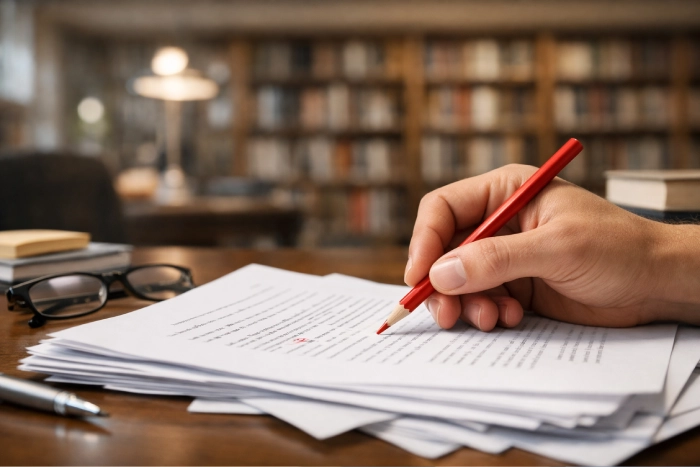
Finishing your dissertation is a big step, but the work is not quite done. Before you submit it, you need to check it carefully. This guide gives you a simple dissertation editing checklist UK students can follow, one step at a time.
Editing and proofreading get mixed up a lot. We do the editing round first (is the argument clear, are the chapters in a sensible order?) and leave the hunt for typos, commas and references until later, which is the part a dissertation proofreading checklist is for.
Why bother, if the research is good? Well, a marker might get through thirty of these in a fortnight, and a page full of small slips looks careless (and costs marks). If English isn’t your first language that can feel like a lot, but in our experience a dissertation proofreading checklist and three or four calm days are usually enough.
Why a Dissertation Editing Checklist Matters
By the time you finish, you’ve probably read your own introduction twenty times. At that point you stop seeing the page and start remembering it. A list that helps here:
- Catches inconsistencies across chapters
- Ensures formatting meets university requirements
- Identifies referencing errors before submission
- Reduces last-minute panic and rushed edits
Dissertation Editing Checklist: Content and Structure
On this first read we’d leave grammar alone, since there’s not much point fixing commas in a paragraph you might cut next Tuesday, and just ask whether the argument works.
The dissertation editing checklist UK students use with us starts with these questions about each chapter:
- Introduction clearly states research problem and aims
- Literature review is critical, not just descriptive
- Methodology justifies chosen approach
- Results are presented without interpretation
- Discussion interprets findings against literature
- Conclusion answers the research question
- Each chapter transitions logically to the next
Ask why they got different results, and which one your data agrees with, and now you’re being critical, which is what Master’s and PhD markers want to see.
One student told us the thing that helped most was a sticky note with their research question on it, stuck to the monitor. We now recommend it to anyone working through the dissertation editing checklist UK chapter by chapter, because off-topic paragraphs are hard to ignore with the question staring back at you.
Dissertation Proofreading Checklist: Language and Grammar
Students ask us how to proofread a dissertation more than almost anything else, and our answer tends to get a groan: read it out loud, every page. It’s slow, but after a dozen readings the ear notices a missing “the” far better than the eye does.
- Use UK English spelling (colour, analyse, programme)
- Check subject-verb agreement and tense consistency
- Remove contractions and informal language
- Verify academic tone and objective voice
- Check sentence clarity and avoid overly long sentences
- Ensure consistent terminology throughout
Then there’s the spell-checker, which has caught our students out more than once by being set to English (US) and letting “color” and “behavior” through. A dissertation grammar and spelling check ought to cover tense as well, which in most dissertations means the past for what you did (“interviews were recorded”) and the present for what’s generally accepted.
For many international students, the real problem is length. A fifty-word sentence is hard to follow, so we’d cut it into two or three. Keep your terms fixed as well: “participants” in Chapter 3 shouldn’t become “respondents” in Chapter 4. Most of how to proofread a dissertation well comes down to this kind of patience.
Referencing and Citation Checklist
Of all the errors we find, referencing ones are probably the most common, and a citation without a matching entry can even end up looking like a plagiarism issue..
- Every in-text citation appears in the reference list
- Reference list entries match in-text citations
- Harvard, APA, MLA, OSCOLA, or Vancouver style applied consistently
- Page numbers included for direct quotes
- Secondary sources cited correctly
- DOI and URLs formatted properly
Harvard is what you’ll meet at most UK universities, although law schools tend to use OSCOLA and a good number of medical schools go with Vancouver.
Formatting and Presentation Checklist
Formatting is the bit nobody enjoys, so it tends to get done at 11 p.m. on the last night when you’re tired, and that’s usually when mistakes creep in. We’d keep the module handbook open the whole time, as the font, spacing and margins you need are all listed in it.
- Font and line spacing meet university guidelines
- Margins and page orientation correct
- Page numbers in required position
- Tables and figures numbered and captioned
- Appendices referenced in main text
- Word count within allowed tolerance
Landscape pages often lose their page numbers, and each table, figure and appendix needs a mention in your text, such as “(see Appendix B)”. On length, a lot of UK universities give you roughly 10% either way, though whether references count changes from one place to the next. Not sure of your total? You can count words for each chapter.
Dissertation Submission Checklist: Final Steps
Our advice is to get through your dissertation submission checklist a full day early. Portals get slow in the last few hours, and we’ve had more than one panicked message at two minutes to midnight.
- Save in required file format (PDF or Word)
- Run plagiarism and AI detection check
- Verify word count including/excluding references
- Check student ID and anonymity requirements
- Submit before deadline via university portal
- Keep confirmation receipt and backup copy
Most UK universities mark anonymously, so your student number goes on the title page and your name doesn’t (not in the file name either, which people forget). It’s worth a minute to check plagiarism online before you upload, too, as one missing pair of quotation marks can push a Turnitin score up surprisingly far.
And keep the confirmation email. Along with a backup copy somewhere other than your laptop, it’s the dullest point on any dissertation submission checklist, but it’s the one that matters if the portal later claims nothing arrived.
When to Seek Professional Editing Help
Lots of students edit their own work perfectly well, but sometimes a second reader is worth it:
- English is not your first language
- Supervisor has requested major revisions
- Tight deadline with limited time for self-review
- Uncertain about referencing or formatting
- Want an objective second pair of eyes
Before you look at dissertation editing services UK companies offer, read your university’s proofreading policy. In general a proofreader may correct language and layout, but the ideas have to stay yours. You can read about our expert writers first, or place your order if you already know what you need.
Common Editing Mistakes to Avoid
The biggest is editing the same evening you finish writing, when you’re far too close to the text. Give it two days at least.
Trusting spell-check on its own comes a close second, since “form” and “from” are both real words and it’ll let either through. Others we’d add are skipping the referencing check because it’s boring, and trying to sort out structure, language and layout in one read. Something always gets left behind that way.
Conclusion
Remember the order more than anything else: structure, then language, then references and layout, and finally the upload. Treat it as a final dissertation review checklist and each part becomes about an evening’s work, which is far easier to face if you’ve started a week or two ahead.
If you’d like a hand with your dissertation proofreading checklist or anything else, our academic support team is happy to help. Visit dissertationhelpservices.uk to find out more.