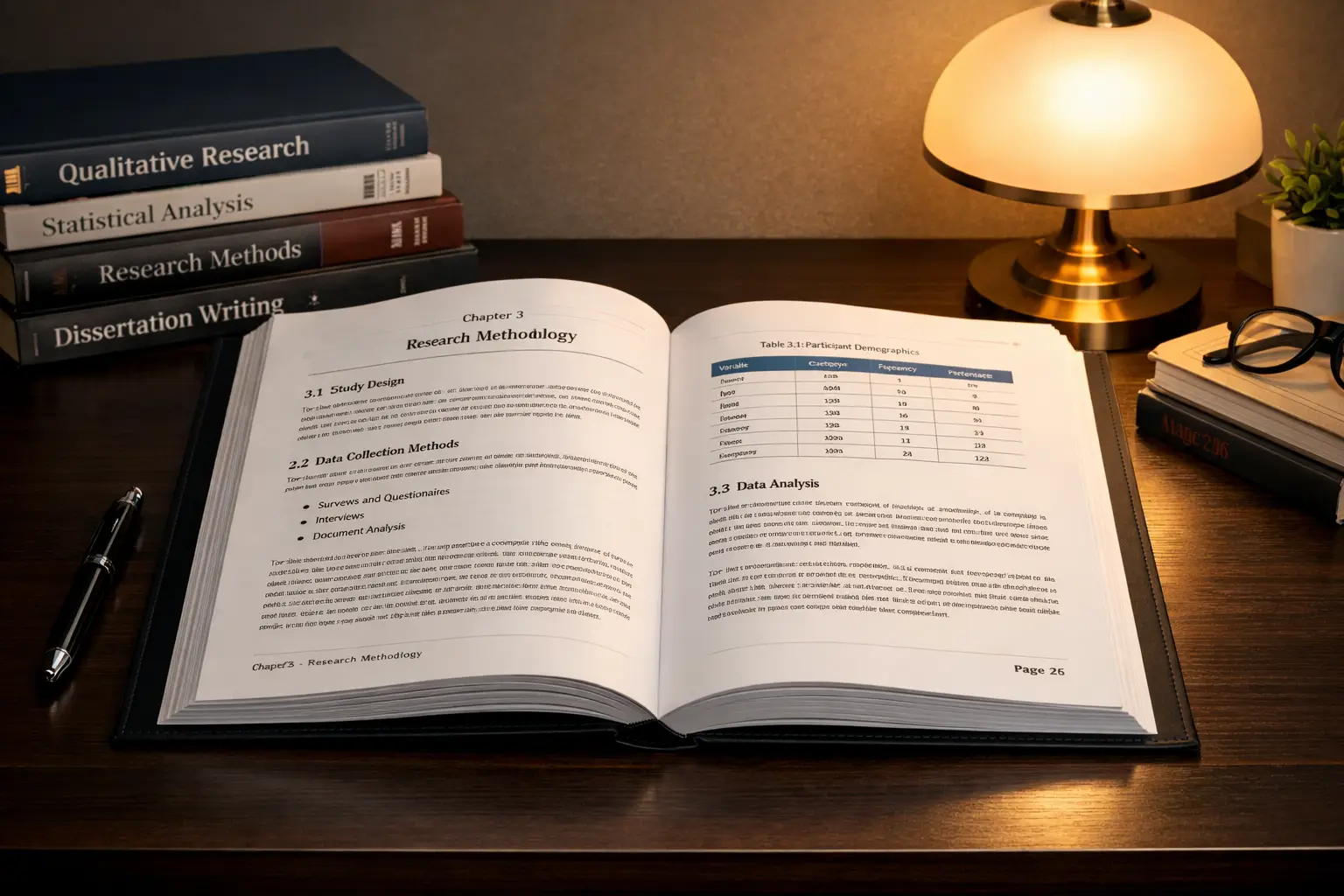
Making your dissertation tidy and presentable is just one aspect of formatting. In actuality, it shows how rigorous your studies are and how closely you can adhere to the rules set forth by the university. This section is often overlooked by researchers, yet it can have a significant effect on final grades. Because of improper formatting, the examiners may even reject the entire piece. There are some universal criteria that are adhered to, despite the fact that every institution in the UK has its own set of regulations. We will go over the many formatting guidelines, referencing styles, and the structure you must adhere to in this dissertation formatting guide. It will be simpler to exhibit your work effectively and professionally after you are aware of these particular guidelines.
General Dissertation Format UK Rules (Margins, Fonts, Spacing)
Even though some universities in the UK follow different referencing style rules, the general ‘dissertation format UK’ is the same everywhere. You need to follow this for proper page layout before you move to the specific requirements.
Margins:
Universities typically want 2.54 cm on all sides. To accommodate binding, the left margin is typically wider, measuring 3.5 to 4 cm.
Fonts:
The most common fonts that are required are Times New Roman and Arial, and the font size needs to be either 11 or 12. Once you have decided on one font and its size, you need to follow it consistently throughout the document.
Line Spacing:
You need to follow double spacing throughout the document. This makes sure the text is easily readable and also leaves space for comments. However, the footnotes and references need to be single-spaced.
Page Numbers:
The page numbers need to be placed either at the bottom centre or bottom right.
These formatting standards will have a considerable impact on the final page count when considering the total breadth of your paper, and ‘How long is a dissertation?’

It's fast and risk-free
Structuring the Document: The Correct Order
When learning how to format a dissertation, you need to understand the correct order of sections. There is front matter that refers to the Title Page, Abstract, and Table of Contents. The main body includes the main chapters, such as introduction, literature review, methods, results, discussion, and conclusion. Here’s how you can structure these sections correctly.
- Title Page: The title page comprises your dissertation title, name, student number, course, department, university name, and submission date. This page isn’t numbered.
- Abstract: Abstract is a brief synopsis of your dissertation. It typically includes the purpose, method, findings, and conclusion in 150 to 300 words.
- Acknowledgements: You can write acknowledgements to thank your supervisor as well as other people who supported you in your research journey.
- Table of Contents: The table of contents lists all chapters and sections, with page numbers. To avoid mistakes, it should be generated with Word’s automated function.
- Chapters: Chapters are the primary section of your dissertation. It usually consists of an introduction, literature review, methods, results, discussion, and conclusion.
- References and Appendices: References are a complete list of all the sources you used. It should adhere to your specified referencing style. Appendices include additional documents such as questionnaires, interview transcripts, and raw data.
For more guidance on how to structure a dissertation effectively, you can check your university handbook. The abstract of your paper also requires you to follow specific formatting rules, so you can refer to our guide on writing a dissertation abstract to ensure this section meets the proper academic standards.
Referencing Styles Explained (Harvard, APA, MLA, Chicago)
One of the most important parts of any dissertation formatting guide is understanding referencing styles. This is because your particular subject decides the type of referencing style you need to use, so it is not up to you to choose the reference style you want.
Harvard Referencing (The UK Standard)
Harvard is the most widely used style in British universities. It is frequently used in subjects such as social science and humanities.
It uses the author-date format, which means you include the author’s name and year in the text.
In-text citation example: (Smith, 2023)
Reference list entry:
Smith, J. (2023). Academic Writing in Higher Education. London: Academic Press.
APA Style (7th Edition)
APA is most commonly used in psychology, education, and related professions. It is similar to Harvard, but the punctuation and formatting guidelines are stricter.
In-text citation example: (Johnson, 2022, p. 45)
Reference list entry:
Johnson, L. (2022). Research methods in psychology. New York, NY: Oxford University Press.
MLA Style
MLA is mostly used in literary and artistic disciplines. It does not use dates in the same manner. Instead, it includes the author’s name and page number.
In-text citation example: (Williams 23)
Works cited entry:
Williams, Sarah. Contemporary Literary Theory. Cambridge University Press, 2021.
Chicago Style
The Chicago style is mostly used in history dissertations. It works differently because it uses footnotes or endnotes instead of in-text citations.
Footnote example: ¹ Robert Thompson, Historical Methods (Manchester: Manchester University Press, 2020), 67.
Bibliography entry:
Thompson, Robert. Historical Methods. Manchester: Manchester University Press, 2020.
Maintaining a single style throughout your work is crucial. If you are unsure, you can look up the correct way to cite a dissertation according to the style you need.
It's fast and risk-free
Formatting Specific Chapters
Understanding how to format a dissertation also means knowing the chapter-specific requirements.
Methodology chapter: In the methodology chapter, there are certain tables and figures that you add. All of these need to be presented in a clear manner. Moreover, the tables need to be numbered properly, such as Table 1, Table 2, and so forth. Each table should also have a clear title, and a source must be mentioned beneath the table. For more advice, check our guide on how to write methodology for dissertation chapters.
Literature review: In this section, you need to add a lot of quotations. For long quotes, such as quotations that are longer than 40 words, you need to use the block quote format. These quotes need to be indented from the left margin, must be single-spaced, and should have quotation marks. When you conduct an effective literature review, correct formatting becomes important to avoid issues like plagiarism.
Results and discussion: These chapters usually have graphs and charts. You need to maintain consistent formatting in between these visual elements with clear labels, legends, and captions. Also, make sure these are of the correct size and of high resolution.
It's fast and risk-free
Common Formatting Mistakes to Avoid
Students need to avoid these common formatting mistakes that are easy to overlook.
- Inconsistent heading styles: Many students use different heading sizes and styles throughout the dissertation. This makes the paper look disorganised. You should use the exact same style in the whole paper.
- Messy table of contents: If the students write the table of contents manually, then there can be certain issues, such as the page numbers not being updated. That’s why the automatic table of contents option should be used.
- Widows and orphans: This happens when a single line of the paragraph stands alone at the top or bottom of the page and breaks the flow of the text. You should activate the settings that most word processors have to correct this.
- Mixing citation styles: One of the biggest mistakes students make is mixing the different referencing styles. For example, using the Harvard style in one chapter and using APA style in the next one. Making this type of mistake impacts your academic credibility.
It can be difficult to see these mistakes, particularly when you’re exhausted. For this reason, some students use professional editing and proofreading services before submitting their work.
Conclusion
Formatting is also an important part of your dissertation. It shows your attention to detail and how well you follow the academic rules. Even though the basic rules remain the same, you should always follow your university guidebook. This ensures that you follow every specific rule that your department might have. If you find formatting difficult or the time is limited, then you can also seek dissertation help services. They can help you to properly format your work.