

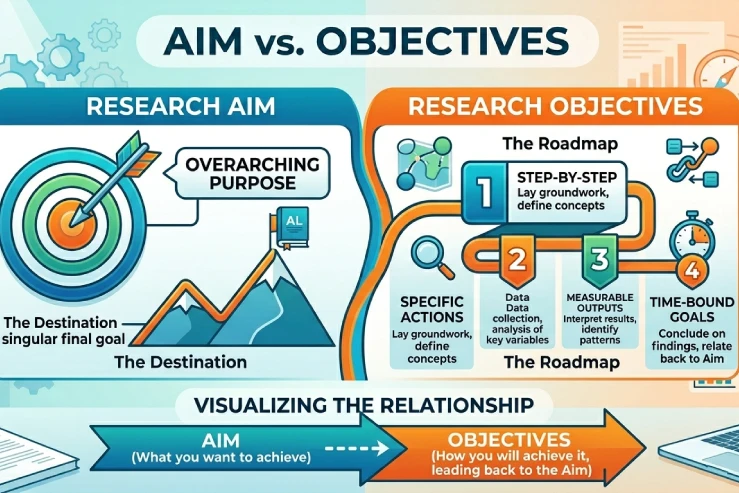
Often, learners struggle to distinguish research aims from objectives. Picture this: reaching New York stands for the aim. Each move toward it defines an objective instead. Reaching the city happens only by completing smaller tasks along the way. Booking travel comes first, then preparing luggage follows. Stepping onto the plane marks another stage completed. Broad purpose shapes the journey’s start. Precise actions shape how progress unfolds. Direction emerges from general intent. Movement depends on structured steps taken one after another.
A clear understanding begins with distinguishing research aim vs objectives, since they shape the core direction of any academic work, commonly established early in the planning phase. When confusion arises about initial steps, support emerges through a dissertation proposal guide, offering structured clarity right from the start.
It establishes the overall course of the dissertation, aiding in the formulation of the research challenge and directing all ensuing choices, guaranteeing coherence, precision, and a solid scholarly emphasis throughout the investigation.

It's fast and risk-free
Defining the Research Aim (The “What”)
The central goal of your dissertation is defined by its research aim. Why does this matter? Because it shapes every part of the investigation. A well-formed objective guides the structure, influencing how questions are framed. Clarity here supports coherence throughout. Readers rely on this anchor to follow the path ahead. Direction emerges not from assumptions, but from deliberate intent.
When looking at range, the purpose stays wide by design. This approach avoids deep specifics, choosing rather to present the core concept behind the study. A single primary goal usually defines a dissertation, supporting consistency across all parts. If more than one intention appears, concentration may weaken, causing the work to seem unfocused.
A research aim tends to follow a specific pattern in wording. Starting with verbs like “to explore” introduces the main focus clearly. Following such terms, the core elements under study appear next. One sees this when looking at dissertation aim examples. Understanding comes through examining these cases closely. The structure reveals itself without needing explanation.
A clear aim often grows out of the topic already selected. When shaping the subject further, choose the perfect dissertation topic comes before defining direction this allows focus to match personal inquiry and scholarly intent. In essence, each section gains guidance from the central aim, moving forward only when tied to an overarching goal.
The research aim defines the overall purpose of the study, outlining what the researcher intends to achieve in broad, clear, and focused terms.
Defining the Research Objectives (The “How”)
Research objectives are the operational methods that deconstruct your main goal into a clear and well-organized plan of action. While objectives are quantifiable steps toward a goal, aims describe the desired result. Every step in the planned evolution is exactly in line with the main goal. Because these factors continuously influence the course of research, it proceeds in a methodical manner.
Each letter within the SMART acronym shapes one part of effective goal design, guiding attention toward practical outcomes. Specific aims avoid vagueness by narrowing intent into clear statements. Measurable components allow progress tracking through observable changes over time.
- Specific: Every goal should unambiguously state what you plan to study.
- Measurable: Goals should have components that make it possible to evaluate results and progress.
- Achievable: They have to be reasonable in terms of time, money, and academic standing.
- Relevant: Every goal should have a clear connection to the primary goal of the study.
- Time-bound: Goals ought to be planned to be finished in a specific amount of time.
Most students aim for between three and five dissertation objectives. Such a number allows thorough exploration while preserving precision. These aims commonly follow an order reflecting how inquiry naturally unfolds.
A well-organized collection of goals can, for instance, consist of: In order to establish a theoretical framework for the study:
- Objective 1 focuses on reviewing existing literature.
- Objective 2 involves gathering pertinent primary or secondary data, depending on the research design.
- Objective 3 focuses on analyzing the data to find patterns, trends, or relationships
- Objective 4 may involve interpreting findings in relation to theoretical frameworks or previous research. Some studies may have an extra goal to assess results or offer suggestions.
Understanding the essential components of a UK dissertation will help you make sure your goals are properly incorporated into your research. In addition to directing your study, well-defined objectives facilitate the clear and organized presentation of your findings.
It's fast and risk-free
Examples: Aim vs. Objectives
A clear distinction between aims and objectives often emerges through real-world cases. Take, for instance, a research project examining work conducted outside traditional offices.
One possible goal behind the investigation could involve examining how working from a distance influences output among staff members. Such phrasing remains general, yet manages to outline the core intent of the project while avoiding detailed procedures.
The purpose shifts when considering specific goals, which divide the broader target into steps that can be followed. One instance would include:
- To identify current remote work trends.
- To survey 100 employees about daily output.
- To compare output data with office-based statistics.
Every goal plays a role in reaching the purpose, keeping the study clear and structured. Such consistency matters most during presentation of outcomes and interpretation. To better understand how evidence connects to goals, consider reviewing the dissertation discussion guide.
When work follows this format, a clear route forms between the starting question and what is eventually found. A progression appears naturally when each part connects to the next without force. From beginning to outcome, movement happens through careful arrangement rather than effort. The shape of the process guides thought forward, step by quiet step. What begins as uncertainty slowly becomes resolution through order alone.
Conclusion
A clear path begins with knowing how aim differs from objectives. Though the main goal sets direction, smaller steps give shape to inquiry. Where one points forward, the other details the route ahead. Alignment turns separate parts into something that holds together. Purpose gains structure when pieces fit without gaps
Still, misalignment between objectives can blur the entire research purpose. When each part is shaped with care and linked deliberately, structure emerges naturally. Clarity grows through precise connections among sections. Quality strengthens when ideas flow without distraction. Communication gains precision where intent remains consistent.
1 thought on “Difference Between Research Aim and Objectives in a Dissertation”
Pingback: Employee Wellbeing and Workplace Productivity Dissertation Topics - Dissertation Help Services